Average Reviews:

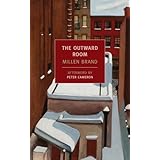
(More customer reviews)Are you looking to buy The Outward Room (New York Review Books Classics)? Here is the right place to find the great deals. we can offer discounts of up to 90% on The Outward Room (New York Review Books Classics). Check out the link below:
>> Click Here to See Compare Prices and Get the Best Offers
The Outward Room (New York Review Books Classics) ReviewAs a fictional record of the awful desperation and crushing poverty that existed during the Great Depression of the 1930s, this is an outstanding example. It also depicts the beginnings of labor unions in this country. I'll admit readily I don't know that much about this aspect of the story, but I'll assume that too is accurate. As a look at the treatment of mental illness and the largely Freudian methods that were in the forefront in the 30s - once again, relevant and probably accurate. I'm not so sure, however, of the accuracy of the depiction of what might go on inside the mind of a manic-depressive woman who has been traumatized by a violent death in her family. But then who can know this for sure? The protagonist, whose real name we never learn, escapes from the Islington Hospital for the insane, where she has been incarcerated for several years or more, due to a mental breakdown following the death of her beloved older brother in an automobile accident. Taking the name Harriet Demuth, she rides the rails of a train, then hitchhikes to NYC, where she begins to try to rebuild a life. She knows she's probably still ill, but serendipitously meets a good and decent man, John, a former coal-miner turned machinist, who takes her in and cares for her and, gradually, they fall in love. Can true love cure mental illness? Well, if Brand's story can be believed, perhaps it can. I'm not inclined to disbelieve.I didn't think I was going to like this story when I began it, but it picked up momentum once Harriet arrived in the city and then was taken in by John. I found myself rooting for this downtrodden couple - the woman tormented by her inner demons and doubts, and the hardworking, enterprising man who tries to do right by her, working long thankless hours at his lathes and drill presses in a machine shop. Harriet too takes a job for a time in a garment factory, a job which finally gave me a descriptive realistic look at what the term "sweat shop" really means. Secondary characters too come alive, in Harriet's shop friend, Anna Tannik, who can't marry her boyfriend because her parents and siblings need her paycheck, miniscule as it may be. Anna's father, let go from his job and beaten down by despair as he searches endlessly for work, pounding the pavements with thousands of other disenfranchised unemployed. And this is a love story too, told in the most simplistic and starkest of terms, but nonetheless, achingly believable.
There is also the symbolism of the "rooms" to consider here: first her room in the asylum, described minutely, then her first three-dollar-a-week room in a New York rooming house, and finally the two-room walkup she shares with John, all examined in detail and described both physically and figuratively. Though not overtly intrusive, there is 'art' in this story, something the critics I suppose loved.
When this book was first published nearly 75 years ago, it sold nearly a half-million copies, an astounding number in those days. It received high praise from the likes of Sinclair Lewis and Theodore Dreiser. And I can see why. Yet Brand never again achieved the recognition or commercial success that he enjoyed with this book, The Outward Room. Before reading this new edition from NYRB Classics, I had never heard of Millen Brand. There's nothing flashy about this novel. But it is a quietly beautiful little book. It didn't deserve to disappear the way it did for over 50 years. I hope it sticks around a while this time. Perhaps it will find a new audience now that our country seems to be on the verge of another Depression. Verge, hell. We're in it, folks. Unfortunately, the kind of anger, fear and desperation depicted in The Outward Room seems relevant once again. For that reason alone it's worth reading. I'm glad I read it. - Tim Bazzett, author of the memoir, BOOKLOVER and the biography, LOVE, WAR & POLIOThe Outward Room (New York Review Books Classics) OverviewThe Outward Room is a book about a young woman's journey from madness to self-discovery. It created a sensation when it was first published in 1937, and has lost none of its immediacy or its power to move the reader. Having suffered a nervous breakdown after her brother's death in a car accident, Harriet Demuth is committed to a mental hospital, but her doctor's Freudian nostrums do little to make her well. Convinced that she and she alone can refashion her life, Harriet makes a daring escape from the hospital—hopping a train by night and riding the rails into the vastness of New York City in the light of the rising sun. It is the middle of the Great Depression, and at first Harriet is lost among the city's anonymous multitudes. She pawns her jewelry and lives an increasingly hand-to-mouth existence until she meets John, a machine-shop worker. Slowly Harriet begins to recover her sense of self; slowly she and John begin to fall in love. The story of that emerging love, told with the lyricism of Virginia Woolf and the realism of Theodore Dreiser, is the heart of Millen Brand's remarkable book.
Want to learn more information about The Outward Room (New York Review Books Classics)?
>> Click Here to See All Customer Reviews & Ratings Now

0 comments:
Post a Comment