Average Reviews:

(More customer reviews)Are you looking to buy The Speed of Light (Ballantine Reader's Circle)? Here is the right place to find the great deals. we can offer discounts of up to 90% on The Speed of Light (Ballantine Reader's Circle). Check out the link below:
>> Click Here to See Compare Prices and Get the Best Offers
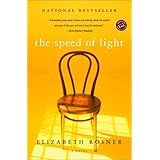
The Speed of Light (Ballantine Reader's Circle) ReviewElizabeth Rosner has written an extraordinary debut novel in "The Speed of Light," an elegant, understated work which tackles such serious themes as the Holocaust's impact on the children of survivors, political massacre in Latin America and the significance of personal connection as a means of liberating the human possibiliites of hope, memory and love. "Speed" is that kind of lovely, slow-paced psychological novel where three decent people, scarred deeply by the anguish of either directly or derivately witnessing horrific suffering, learn that shared memory, tenderness and the need to risk everything for love assist them in overcoming the pain of a murderous past. This brilliant work ultimately is about possibilities: of living in a world drenched with blood, of overcoming enormous personal fears, of embracing one another's past to insure the chance of mutual survival.Each of the three central characters has a unique voice (so much so that this latticed work includes three different type settings) and presents his or her own complicated confrontation with silence and memory. Each character gropes for meaning; each confronts the terror of the past, the anguish of living a solitary life and the desperate fear of abandonment, great sadness and existential isolation. Each character learns the nobility of bearing witness.
Julian Perel has absorbed the silence and imagined Holocaust memory of his father, Jacob. Living upstairs from his musically-gifted sister, Julian is an obsessive recluse, immersed in a life of suffocating detail, terrified of human touch, suspicious of language and voice. He theorizes that his father "gave up his language because it belonged to the killers; he could not live with the sounds of their voices inside his own." Like his now deceased father, Julian speaks in "the vocabulary of science and never reveal[s] his heart." Tormented by a past which he does not fully comprehend but which dominates his personality, Julian's self-imposed isolation is at once a private punishment and a social rebuke. It is only through his halting relationship with Sola, a hired housekeeper, that he begins the process of personal integration.
Hired by Paula Perel to oversee her downstairs apartment while pereforming in Europe's opera houses, Sola expands her domestic obligations as she initiates a friendship, a relationship, with the reluctant Julian. Sola, ravaged by memories of her village's annihilation at the hands of a brutal Latin American despotism, has her own torment, unshared and terribly burdensome. Slowly, quietly, Sola and Julian begin to learn a central lesson: sharing memories and making others become derivative witnesses to social evil is a good thing. By permitting this "buried language" to surface, Sola initiates a process by which both Julian and she perceive the possibilities of life.
The most tragic figure in "Speed" is Paula Perel, whose operatic voice soars through her apartment and vibrates with immediate beauty. Seemingly oblivious to post-Holocaust trauma, Paula sets out to Europe to test the quality of her voice. There she discovers the hidden story of her family's past with shattering consequences. Where Julian has had a lifetime to absorb memory and silence, Paula has but days. She learns that inflicted silence "bruises the heart," that her father's heart must have been "completely black and blue from a lifetime of sorless grief banging around in his chest." How Paula confronts both her own personal crisis and the implications of the Holocaust on her professional life is one of the many instructive moments of the novel.
"The Speed of Light" is nothing less than brilliant. Invoking the Hasidic teaching that "there are three ways to mourn: through tears, through silence, and by turning sorrow into song," Elizabeth Rosner has crafted a moving novel about love and meaning and connection in the midst of remembered pain and sorrow. Through her sensitive portrayal of three fully-imagined protagonists, Rosner teaches us that people can emerge from the wilderness of despair to the refreshing oasis of possibility, voice and connection.The Speed of Light (Ballantine Reader's Circle) Overview
Want to learn more information about The Speed of Light (Ballantine Reader's Circle)?
>> Click Here to See All Customer Reviews & Ratings Now

0 comments:
Post a Comment