Average Reviews:

(More customer reviews)Are you looking to buy The Kill (Oxford World's Classics)? Here is the right place to find the great deals. we can offer discounts of up to 90% on The Kill (Oxford World's Classics). Check out the link below:
>> Click Here to See Compare Prices and Get the Best Offers
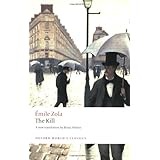
The Kill (Oxford World's Classics) Review"La Curée" is a hunting term in French that can't be easily translated. It's the moment when all the hounds and hunters have trapped or treed their prey and are closing in for "The Kill". The bloodthirtsy hounds of Zola's "La Curée" are the unscrupulous capitalist speculators of the French Second Empire (1852-1870) of Louis Napoleon, whose greed and decadence are unleashed by the first great "urban renewal" of modern times, the expropriation of huge swathes of Paris for the constructing of the boulevards. "The Kill" is a novel of Passions, of the lust for money and of sexual lust, but the most fiery Passion of all is Zola's own passionate hatred of the Second Empire, which he portrays as morally and aesthetically rotten to the core.Was there ever a novel before "The Kill" in which every character is completely odious? Even in Zola's previous novel - The Fortune of the Rougons - there were a couple of sympathetic innocents, but the three principal actors of "The Kill" are loathsome from start to finish. Aristide Saccard is the son of the Pierre Rougon who pounced on Napoleon III's coup d'etat to 'lift' the Rougons from poverty in that first novel. Maxime is Aristide's effete son by his first wife in the village of Plassans, whom we met in "The Fortune" but whose death in "The Kill" affords Aristide his first opportunity to swindle his way to wealth in Paris. Renée is Aristide's second, much younger wife, whose dowry provides that opportunity. The novel "The Kill" is a tightly choreographed ballet, a 'pas de trois' of deception and seduction danced by these three despicable people, each one aiming to extract as much 'blood' from the other two as possible. In the latter chapters, in fact, explicit mention is made of "Phedre", that classic of the French theater, a drama of incestuous desire and suicide. One could read Zola's "La Curée" as a bold trope on the story of Phedre.
What pleasure can there be in reading a novel about three equally hateful characters in a menage a trois? You won't be able, dear reader, to take sides. The pleasure is all in the art of Zola's writing, and perhaps in the fervor of his historical denunciation of the Second Empire, which does seem surprisingly to resemble the state of things in "The World's Only Superpower" of 2010. The promiscuity and extravagance of Zola's Paris are not unmatched in today's America.
"The Kill" is an architectural masterpiece, a novel as precisely constructed as the Eiffel Tower and as ornate as the façade of any church or chateau in France. The first chapter, indeed, is a kind of extravagant façade of description, page after page of opulence -- clothing, carriages, furniture, palatial dwellings, all the trappings of excess and insatiable lust that swirl around Renée and Maxime (stepmother & stepson) like objects of Bacchanalia tossed in a tornado. Later in the novel, when the 'inevitable' occurs between Maxime and Renée, Zola portrays their ecstasy with the same brilliant indirection, describing the sensuous, narcotic luxury of Renée's bedroom rather than the sordid physical actions that occur in it. One can be seduced -- over-stimulated -- by Zola's powers of description. I read "La Curée" in French, by the way, and I relished this first chapter so much as poetic language that I found myself reading it aloud, something I rarely do.
There are twenty novels in Zola's "Rougon-Macquart" series, his epic depiction of French society and history through the interconnected lives of the descendants of two families from the Provençal village of Plassans. I've read and reviewed a couple of the later novels out of order, specifically "The Debacle" and "The Masterpiece". Eventually I may have to challenge Master Zola on a certain kind of double standard of sexual morality. In "The Kill", he is implacable in his condemnation of dissolute, decadent sexual frenzy among the "upper" classes of wealth and power. In "The Masterpiece", portraying the Bohemian lifestyle of the Impressionist painters and writers, he is far less minatory, far more indulgent. But hey, don't I feel the same ambivalence myself? Oddly enough, the original serialization of "La Curée" was interrupted in 1871 - censored by the government - ostensibly for its "immorality", and Zola was widely perceived as a 'prurient' writer, especially by British and American readers. In fact, in "The Kill" at least, he's as censorious as Savonarola or Jonathan Edwards.
This Oxford edition translation by Brian Nelson is the first since the end of the 19th C. I looked it over in a bookstore. It seems quite readable and representative of Zola's craft. I don't think you need to have read "The Fortune of the Rougons" or any other of Zola's books to appreciate "The Kill". A little knowledge of French history, and a tourist's visual impression of Paris, would facilitate your appreciation, but even those things are not necessary. "The Kill" is an awfully good novel.The Kill (Oxford World's Classics) OverviewThe Kill (La Curée) is the second volume in Zola's great cycle of twenty novels, Les Rougon-Macquart, and the first to establish Paris - the capital of modernity - as the centre of Zola's narrative world.Conceived as a representation of the uncontrollable 'appetites' unleashed by the Second Empire (1852-70) and the transformation of the city by Baron Haussmann, the novel combines into a single, powerful vision the twin themes of lust for money and lust for pleasure. The all-pervading promiscuity of the new Paris is reflected in the dissolute and frenetic lives of an unscrupulous property speculator, Saccard, his neurotic wife Renée, and her dandified lover, Saccard's son Maxime. About the Series: For over 100 years Oxford World's Classics has made available the broadest spectrum of literature from around the globe. Each affordable volume reflects Oxford's commitment to scholarship, providing the most accurate text plus a wealth of other valuable features, including expert introductions by leading authorities, voluminous notes to clarify the text, up-to-date bibliographies for further study, and much more.
Want to learn more information about The Kill (Oxford World's Classics)?
>> Click Here to See All Customer Reviews & Ratings Now

0 comments:
Post a Comment